
12 Agentic Ecommerce Workflows Already Running in 2026
The frustrating thing about agentic ecommerce coverage is how much of it is still hypothetical.

Post-Purchase Agents
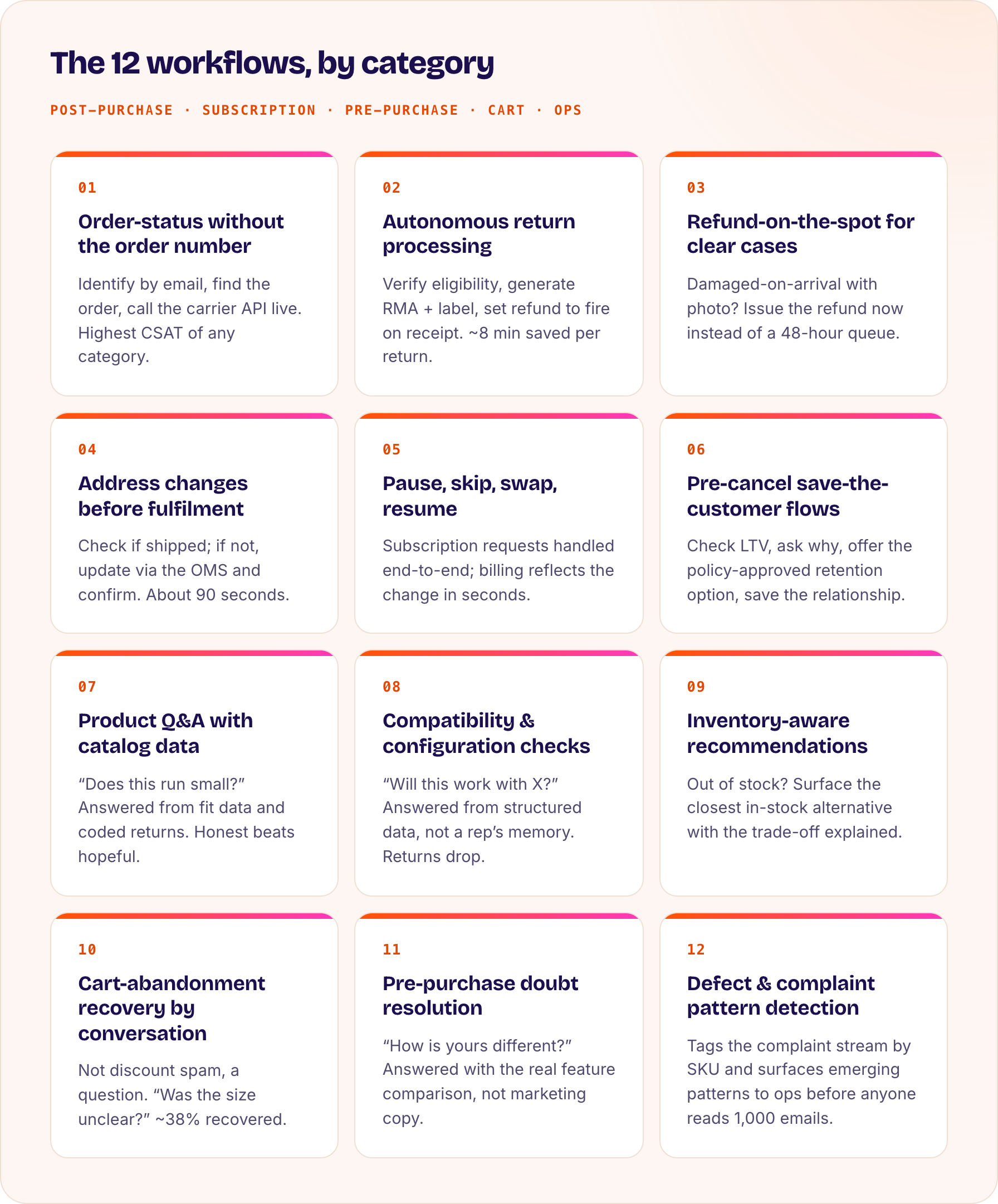
1. Order-status resolution without the order number
A customer emails “where’s my package?” The AI agent identifies them by email, finds the open order, calls the carrier API live, and answers with the actual location, ETA, and reason for any delay. No order number requested, no template reply. CSAT on this workflow is the highest of any category, typically 4.7 or higher.
2. Autonomous return processing
The agent verifies eligibility against policy, generates the RMA, issues the label, sets the refund or store credit to fire on receipt, and replies with everything the customer needs. Tier-one human time saved per return: roughly 8 minutes.
3. Refund-on-the-spot for clear cases
For obviously valid refunds, damaged on arrival with photo, missing item with order confirmation, the agent issues the refund immediately instead of opening a 48-hour investigation queue. Customers stop reading the apology line and just say thank you.
4. Address changes before fulfilment
The classic “I just realized I typed my old address” panic email. The agent checks if the order has shipped, and if not, updates the address through the OMS API and confirms. About 90 seconds.
Subscription Agents
5. Pause, skip, swap, resume
Subscription requests are usually high-frequency, low-complexity, and chronically under-served by human teams. Agents handle them end-to-end: pause for two cycles, skip the next box, swap to the larger size, resume in March. The billing system reflects the change in seconds.
6. Pre-cancel save-the-customer flows
When a subscriber clicks cancel, the agent checks lifetime value, asks why, offers the policy-approved retention option (discount, skip, pause, alternate SKU), and saves the relationship when it can, without forcing the customer through five escalations.
Pre-Purchase Agents
7. Product Q&A with structured catalog data
A pre-sale visitor asks “does this run small?” The agent checks the SKU’s fit data and past returns coded as size issues, then answers honestly: “Returns for size run about 12 percent on this SKU; consider sizing up.” Honest beats hopeful, and conversion goes up.
8. Compatibility and configuration checks
For brands with multi-SKU compatibility, the agent answers “will this work with X?” with structured catalog data rather than a sales rep’s memory. Returns drop when the answer is reliable.
9. Inventory-aware recommendations
A customer wants something out of stock. The agent surfaces the closest in-stock alternative, with the trade-off explained, instead of a generic “we’re out, sorry” reply.
Cart and Conversion Agents
10. Cart abandonment recovery via conversation
A cart sits idle. The agent reaches out, not with discount-spam email, but with a question: “Was the size unclear?” “Did shipping feel high?” Top implementations recover around 38 percent of abandoned carts with conversation rather than blind discount.
11. Pre-purchase doubt resolution
A customer pastes a competitor’s URL and asks “how is yours different?” The agent answers truthfully and structurally, with the actual feature comparison drawn from the catalog and the brand’s positioning doc. Conversion lift is meaningful precisely because the answers feel real.
Operations and Quality Agents
12. Defect and complaint pattern detection
The least visible but possibly most valuable workflow. The agent watches the incoming complaint stream, tags by SKU and reason, and surfaces emerging patterns to operations before anyone has time to read a thousand emails. “Five customers in two days mentioned a smell on SKU 4419.” That alert lands in the right inbox at 9 a.m.
What These Have in Common
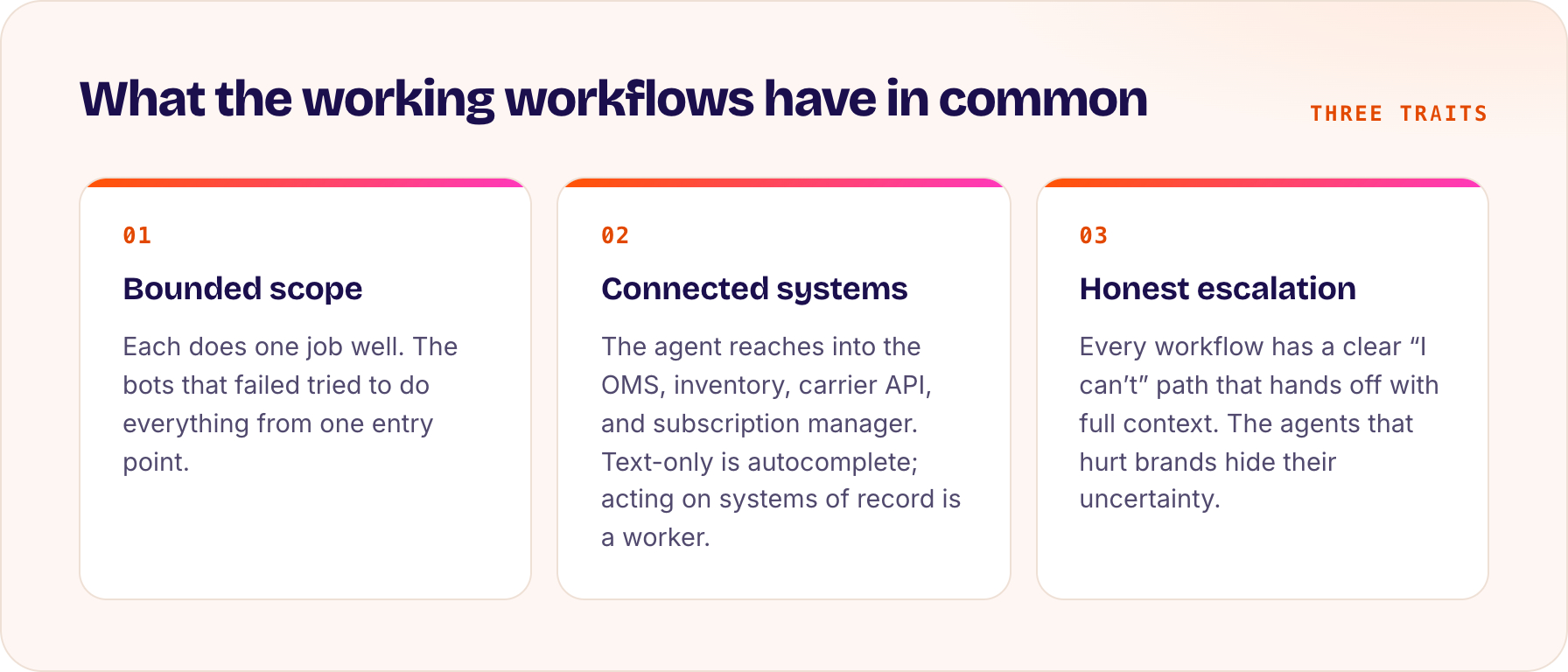
Three traits separate the workflows that actually work from the ones that crash on contact with reality.
How to Know Which to Start With
Run a quick audit of your last 1,000 tickets and group them by reason. The top three categories are probably 50 to 70 percent of your volume. Start there. Two well-deployed workflows on the highest-volume categories will beat a half-implemented rollout on twelve categories every time.
Frequently Asked Questions
1) What are agentic ecommerce workflows?
Autonomous, AI-led processes where an agent completes a commerce task end-to-end, resolving an order-status question, processing a return, or recovering a cart, by acting on real systems within policy.
2) Which agentic workflow should I deploy first?
Order status: highest volume, narrowest scope, cleanest data, and the highest CSAT of any category. Audit your last 1,000 tickets to confirm your top categories.
3) Are these agentic AI use cases actually in production?
Yes. The 12 above are running at ecommerce brands today, including autonomous returns, subscription changes, and conversational cart recovery.
4) How much agent time does a return workflow save?
Roughly 8 minutes of tier-one time per return when the agent handles eligibility, RMA, label, and refund end-to-end.
See Evo in action, running on your store
Book a 30-minute walk-through to see how Evo fits on your actual catalog, your support tickets, and your real search queries — and see your real customer graph in action