
AI Helpdesk for BigCommerce: The 2026 Implementation Guide
If you have been researching AI helpdesks for your BigCommerce store, you have already hit the problem: nine of ten guides assume you are on Shopify.


Why Most AI Helpdesk Guides Assume Shopify
Gorgias built its entire content and product ecosystem around Shopify, and Richpanel followed a similar path. That is fine if you are on Shopify. If you are on BigCommerce, it means you are evaluating tools where your platform is a secondary integration, not the primary one.
That matters because BigCommerce stores do not look like Shopify stores. The platform skews mid-market and enterprise: more complex catalogs, more B2B accounts, more headless deployments, more multi-storefront setups. A tool tuned for a Shopify DTC brand will handle basic FAQ deflection on BigCommerce and struggle with everything else.
Why BigCommerce Stores Have Different Requirements
Four areas separate BigCommerce from the standard Shopify integration.

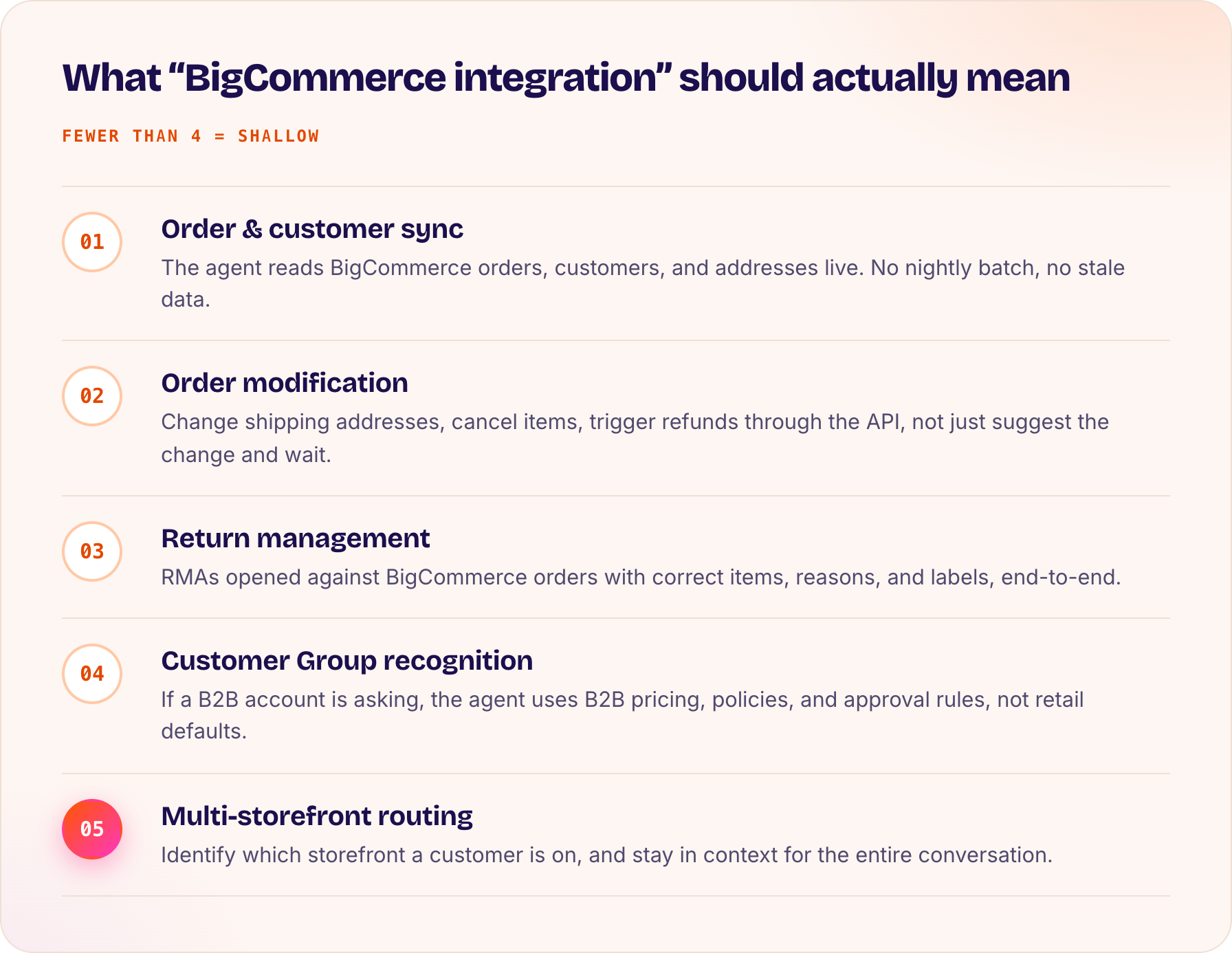
What “BigCommerce Integration” Should Actually Mean
Five checkpoints separate real integrations from checkbox claims. Anything less than four of these and the integration is shallow, the agent will handle FAQs but will not resolve tickets.
Platforms Worth Evaluating in 2026
Richpanel, Gladly, and Kustomer all support BigCommerce as a first-class integration. Richpanel leans into ecommerce-specific self-service, Gladly toward premium CX, and Kustomer toward AI-CRM workflows.
Platform-agnostic agentic platforms, such as getevo.ai, focus on agent capability first and treat BigCommerce, Shopify, WooCommerce, and headless setups as equal targets. The bet is that ecommerce platforms are converging on similar APIs, so the agent should not care which one is underneath.
General-purpose AI customer service with ecommerce add-ons is worth considering for B2B-heavy BigCommerce stores where ecommerce-native players lack strong B2B support. Verify the ecommerce workflows are not bolted on.
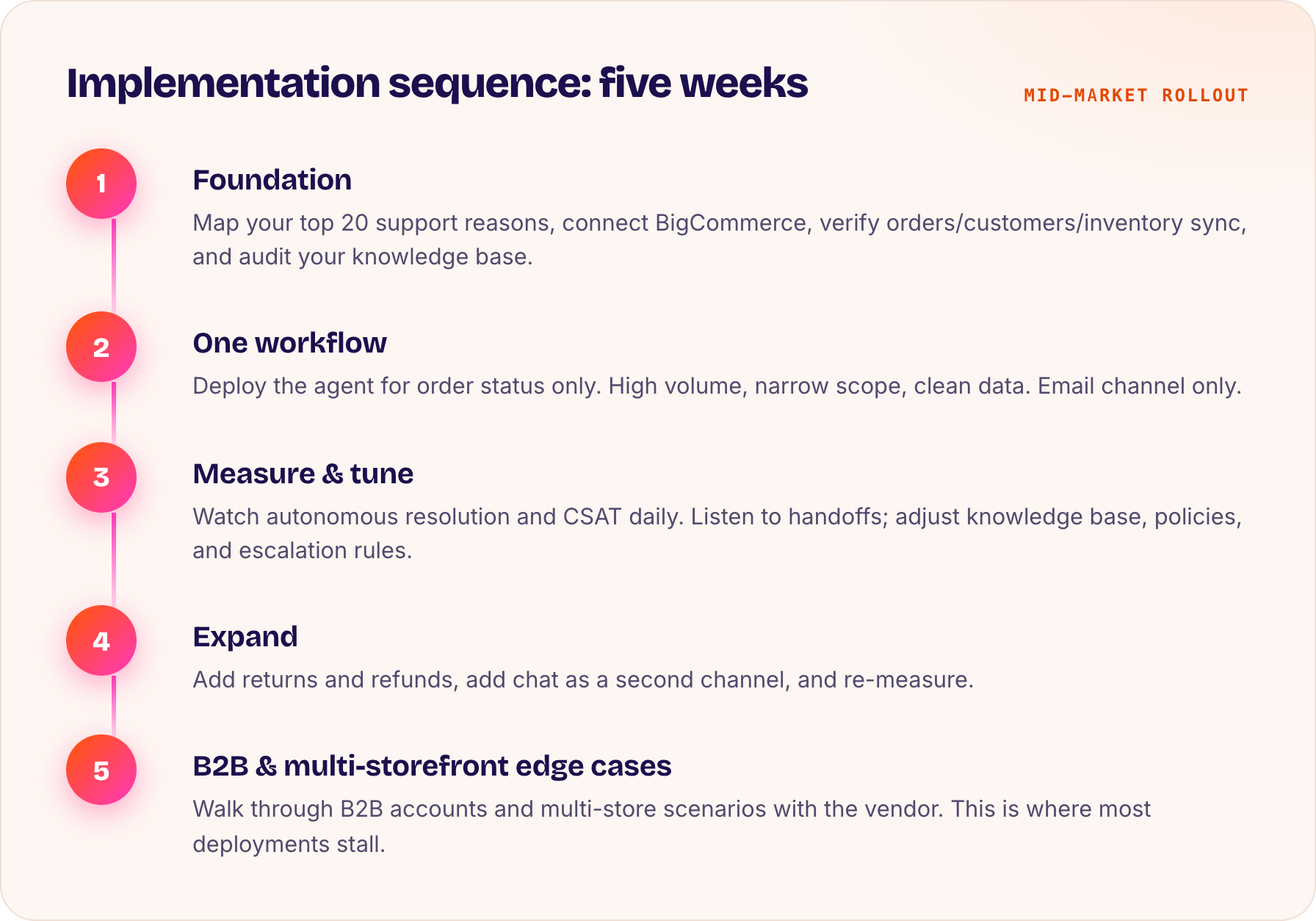
Implementation Sequence: Five Weeks
Three Pitfalls Specific to BigCommerce

Before You Commit
Send the candidate platform three real customer questions from your inbox and watch the agent solve them in your BigCommerce instance, not in their canned demo store. If they cannot handle your actual catalog, your actual B2B pricing, and your actual multi-storefront setup, walk away. In 2026, that capability is table stakes.
Frequently Asked Questions
1) Does an AI helpdesk work with BigCommerce?
Yes. Most modern AI helpdesks support BigCommerce via its REST API. The difference is depth: whether the agent can modify orders and process returns, or only answer FAQs.
2) What is the best AI helpdesk for a B2B BigCommerce store?
Prioritize platforms that recognize Customer Groups and price lists and can apply B2B pricing and approval rules. Test with a real B2B customer record before signing.
3) How is an AI helpdesk on BigCommerce different from Shopify?
BigCommerce stores are more likely to be multi-storefront, B2B, and headless, so integration must handle store routing, Customer Groups, and a more variable order schema.
4) How long does BigCommerce AI helpdesk setup take?
A realistic mid-market rollout is about five weeks: foundation, one workflow, tuning, expansion, then B2B and multi-storefront edge cases.
See Evo in action, running on your store
Book a 30-minute walk-through to see how Evo fits on your actual catalog, your support tickets, and your real search queries — and see your real customer graph in action