
AI Helpdesk for Ecommerce: The 2026 Buyer’s Guide
Every Shopify brand has been pitched an AI helpdesk in the last 18 months, and the pitch never changes: fewer tickets, lower costs, better CSAT.

What Is an AI Helpdesk for Ecommerce?
An AI helpdesk for ecommerce is customer service software that uses AI agents to resolve store-specific requests end-to-end. It looks up an order, edits a shipping address, issues a refund, and recommends a product, rather than just routing tickets or drafting replies. A general AI helpdesk suggests answers. An ecommerce AI helpdesk takes action against your order management system before a human is involved.
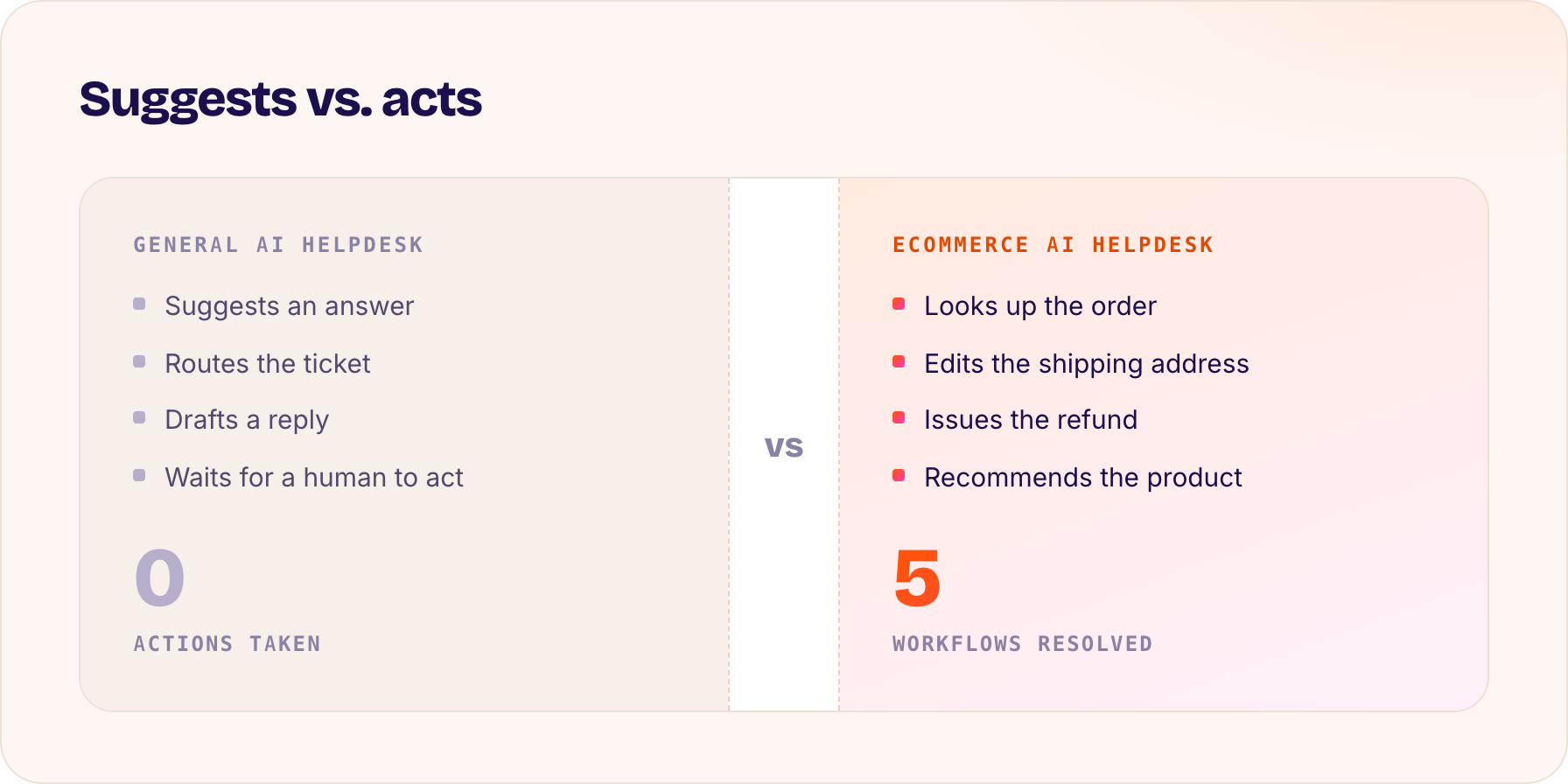
The shift in 2026 is from deflection to resolution. The old metric was how many tickets the bot avoided. The new one is how many tickets the AI agent actually closed, correctly, with the customer satisfied. That is a different system, and most AI helpdesk software was not built for it.
Why Ecommerce AI Helpdesk Adoption Accelerated in 2026
Three forces pushed AI customer service software from “nice to have” to default.
Ticket volume scaled faster than headcount. One launch email can quintuple inbound support volume in 24 hours, and AI agents absorb spikes without queue collapse. Customer expectations moved too, shoppers now expect WISMO answered without typing an order number, returns they can start themselves, and sub-five-minute chat response. And the unit economics finally work: most brands report a 30 to 70 percent cost reduction in tier-one support within 90 days, which beats outsourcing even at conservative resolution rates.
What a Good Ecommerce AI Helpdesk Actually Does
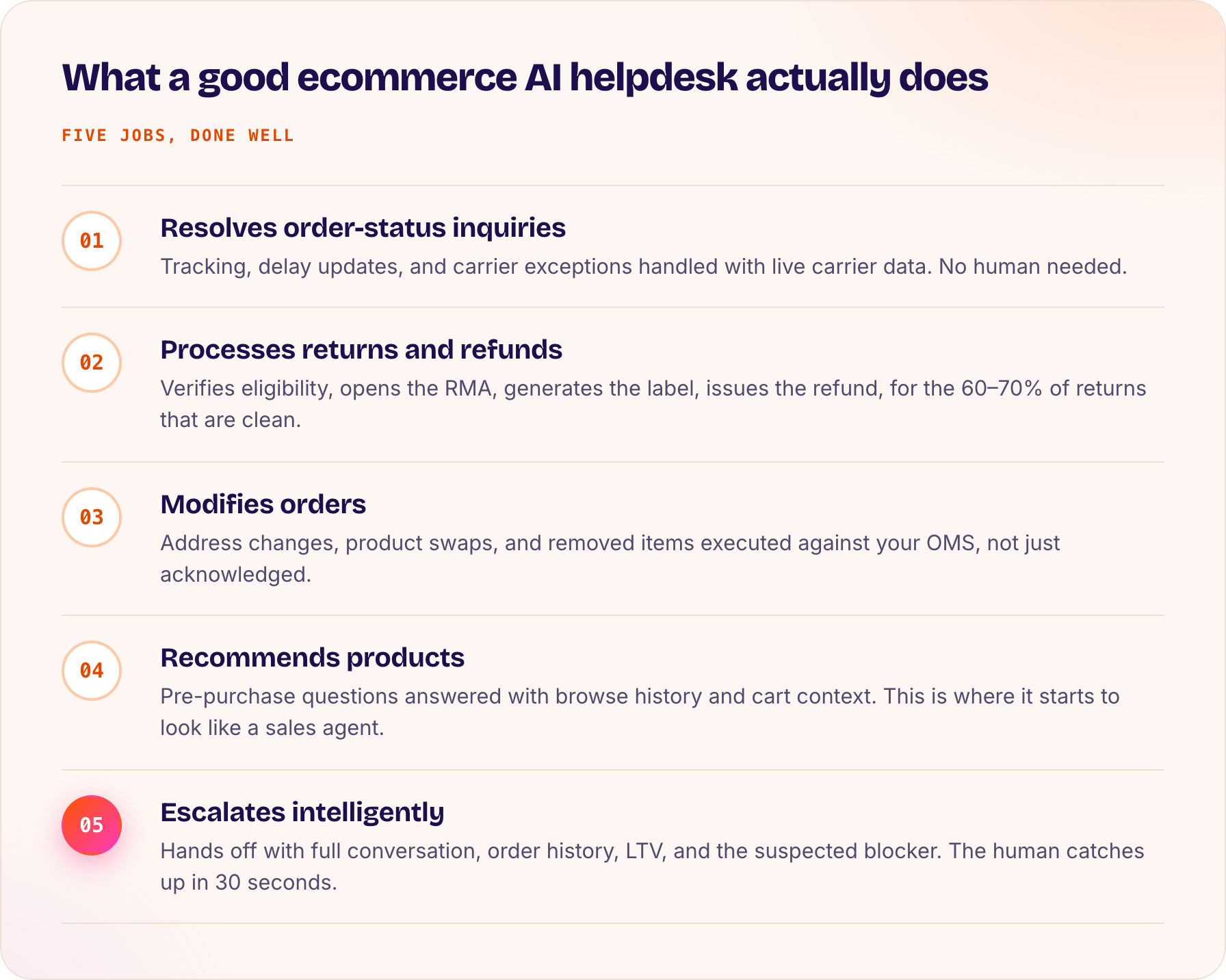
Strip away the marketing copy and a competent ecommerce AI helpdesk does five things well.
How the Leading Platforms Compare
Gorgias
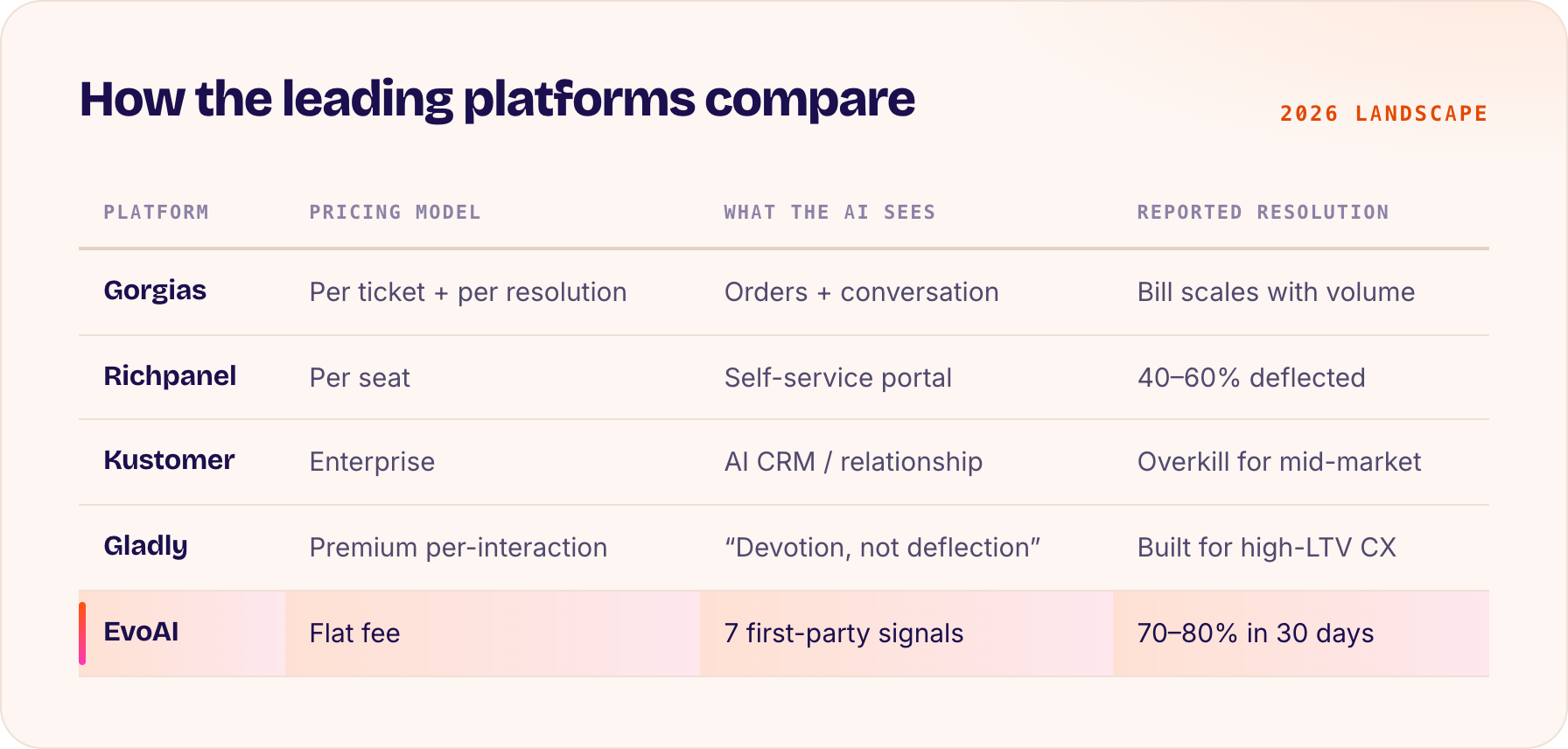
The Shopify-native default. Deep platform integration, strong post-purchase AI, and a growing push into pre-sale with its Shopping Assistant. What to watch: it charges per ticket and per AI resolution, so your bill scales with volume. The AI sees order history and conversation but no browsing data, source attribution, or behavioral context. The more AI resolves, the more you pay.
Richpanel
Leads on self-service portals and claims 40 to 60 percent of typical ecommerce queries are handled without an agent. What to watch: self-service is deflection, not resolution, the customer does the work. Per-seat pricing means you pay for agent chairs even when AI handles the tickets.
Kustomer
Approaches the problem as an AI CRM. Strong for brands that treat customer service as a relationship motion. What to watch: enterprise pricing, complex setup, and overkill for most mid-market DTC brands.
Gladly
Positions on premium CX, with “devotion not deflection” as the philosophy. What to watch: premium pricing to match. Built for brands where LTV justifies high per-interaction investment, not the cost-reduction math most Shopify brands are running.
EvoAI
Agent-native. The AI executes workflows, refunds, exchanges, modifications, end-to-end rather than deflecting them. It runs on Blotout’s first-party data layer, so the AI sees browsing behavior, source attribution, LTV, and session context before the first message. Flat-fee pricing means more AI resolution lowers cost per ticket instead of raising the invoice. EvoAI reports 70 to 80 percent autonomous resolution within 30 days.
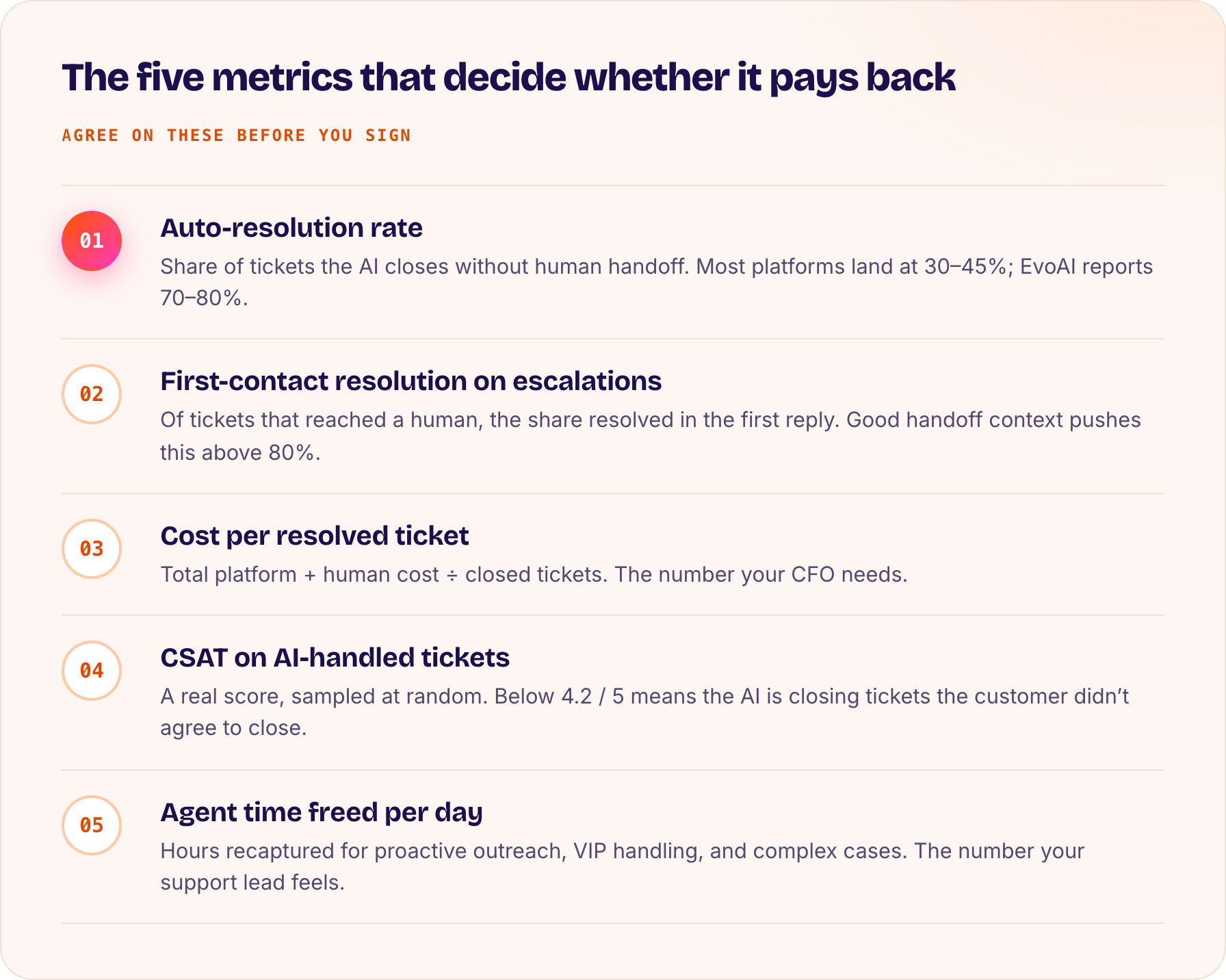
The Five Metrics That Decide Whether It Pays Back
Before you sign a contract, agree on these five numbers with your team.
Two Reasons to Wait
If your knowledge base is incomplete or outdated, the AI will be confidently wrong. Fix source-of-truth content first.
If your returns policy and SLA logic are not machine-readable somewhere, the AI has nothing to execute against. Standardize before adding the automation layer. This is the most common reason early deployments fail.
Where to Start
Pick the one workflow that costs your team the most agent-hours, usually order tracking or returns. Deploy for that workflow alone, measure for four weeks, then expand. Two-workflow deployments succeed at roughly twice the rate of full-rollout attempts: narrow scope, fast feedback, clear ROI.
Frequently Asked Questions
1) What is the difference between an AI helpdesk and ecommerce customer service software?
An AI helpdesk is the AI layer. Ecommerce customer service software is the broader platform it sits in. The distinction that matters is whether the AI resolves (acts on your OMS) or merely deflects (answers and routes).
2) How much does an AI helpdesk for ecommerce cost?
Pricing models vary: per-ticket or per-resolution (Gorgias), per-seat (Richpanel), enterprise (Kustomer, Gladly), or flat-fee (EvoAI). The number to compare is cost per resolved ticket, not headline price.
3) What auto-resolution rate is realistic?
30 to 45 percent for most platforms in a mature deployment, and 70 to 80 percent when the agent has rich first-party context. Be skeptical of any vendor promising more than 70 percent in week one without a guarantee.
4) Which AI helpdesk is best for a small Shopify store?
Start with the platform whose pricing matches your volume and whose integration is deepest for your stack. Run a one-workflow pilot (order status) before committing.
See Evo in action, running on your store
Book a 30-minute walk-through to see how Evo fits on your actual catalog, your support tickets, and your real search queries — and see your real customer graph in action